
Consulting has priced skilled time for a century, and AI reduces the time a given piece of skilled work takes. The findings of the revenue and pricing chapter of our 2026 report follow from that: AI work is growing as a share of firm revenue, clients increasingly want systems built rather than recommendations delivered, and fees are moving from hours towards outcomes. Below are the figures the firms have disclosed, the mechanism, and the four models emerging in response.
Key takeaways
- Gartner expects the AI services market to grow from $436 billion in 2025 to $759 billion in 2027, a 31.9% compound annual growth rate.
- BCG's AI- and technology-focused services went from 20% of $13.5 billion in 2024 to 40% of $14.4 billion in 2025. Bain says about 30% of its 2025 business was technology- and AI-enabled, with more than 2,500 AI projects delivered. McKinsey counts 25,000 AI agents in a 60,000-strong workforce.
- Clients are moving from buying advice to buying execution, and AI is pushing them towards outcome-based fees. Both trends weaken the billable hour.
- Four business models are emerging in place of daily and hourly rates: outcome-based, consulting-as-a-service, asset-based, and premium handmade consulting. Most firms will run more than one.
AI is taking a growing share of consulting revenue
The latest figures from the large firms point the same way: AI accounts for a growing share of projects and income, in a market that is itself expanding quickly.
| Firm or source | What is disclosed | As reported |
|---|---|---|
| Gartner[1] | AI services market size | $436 billion in 2025, expected to reach $759 billion in 2027 (31.9% CAGR) |
| BCG[2] | Revenue and share from technology advisory including AI | 2024: $13.5 billion, 20% technology advisory. 2025: $14.4 billion, 40% AI- and technology-focused services |
| BCG X | Headcount of the unit building custom AI systems for clients | More than 3,000 employees |
| Bain & Company[3] | Share of business that is technology- and AI-enabled | About 30% in 2025; more than 2,500 AI projects delivered to date |
| McKinsey & Company[4] | QuantumBlack headcount; total workforce | QuantumBlack: more than 1,700 staff. Workforce of 60,000 including 25,000 AI agents |
BCG's disclosure shows a mix shift rather than growth alone. The AI and technology share doubled in a year while total revenue grew modestly, which means AI work is displacing what used to be sold as pure advisory. Total revenue is stable while the product underneath it changes.
Clients are buying execution, not advice
The growing AI share reflects a change in what clients pay for. Rather than advice alone, they want the system built and running. BCG's CEO Christoph Schweizer describes the firm's work in those terms: redesigning entire workflows and upskilling organisations so that AI shows up in the P&L and in how people work rather than in token consumption, with a growing share of value-based projects.[2]
This is why the large firms built delivery units rather than practice groups. BCG X, QuantumBlack and their equivalents exist because a strategy deck about AI does not command the fee a deployed system does, and because clients increasingly ask for the system before they will pay for the advice.
Why the billable hour is weakening
The billable hour priced scarcity: a finite supply of skilled time, sold by the unit. AI makes the same deliverable take less time. If a firm keeps billing hours, revenue per engagement falls even as margin per hour rises. If it keeps the price, the client can see that the hours no longer justify it. In either case the unit of sale no longer describes the value. The report also finds movement on the demand side: AI is pushing clients towards outcome-based fees.
McKinsey leadership indicated in November 2025 that roughly 25% of the firm's fees are now tied to outcomes rather than billable hours.[5]
Four emerging business models
A collective white paper published in 2026 by the HEC Paris Alumni Club Consulting & Coaching, reproduced in our report, maps the move from today's daily or hourly rate to four models for the AI age.[6] The framework is the club's, and we reproduce it as the clearest summary we have found of where pricing is heading.
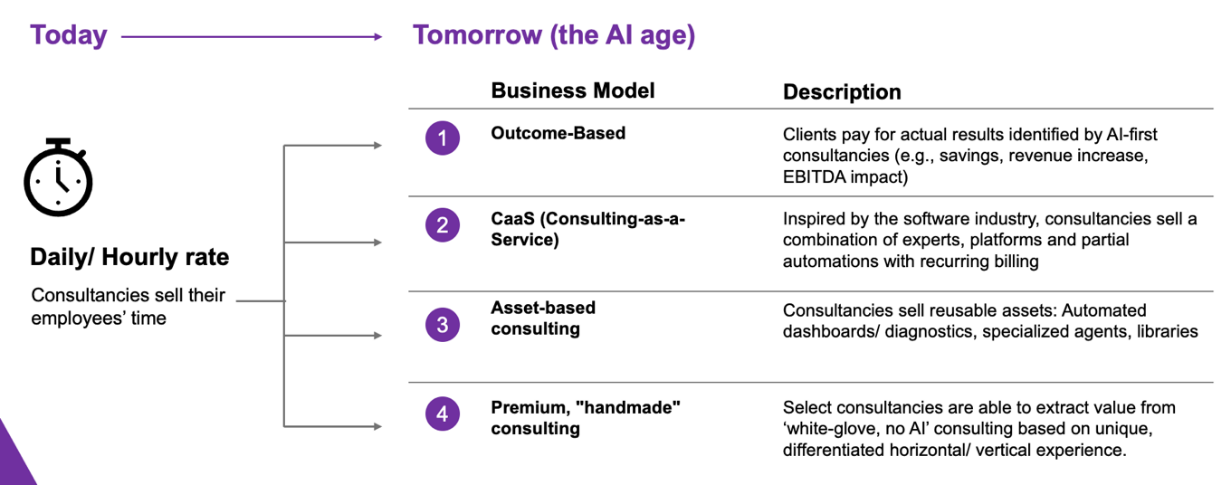
The trade-off behind each model
| Model | What the client pays for | What the firm gains | What the firm takes on |
|---|---|---|---|
| Outcome-based | Actual results: savings, revenue increase, EBITDA impact | Alignment with the client and a premium when results land | Delivery risk moves onto the firm; measurement and attribution must be agreed up front |
| Consulting-as-a-service (CaaS) | A combination of experts, platforms and partial automations on recurring billing | Predictable, recurring revenue and a standing client relationship | Software-style obligations: uptime, maintenance, continuous improvement |
| Asset-based consulting | Reusable assets: automated dashboards, diagnostics, specialised agents, libraries | Margin that scales without headcount; IP that compounds | Upfront investment in assets that may date quickly as models change |
| Premium, handmade consulting | White-glove, no-AI advice based on unique, differentiated experience | Scarcity pricing for judgment that cannot be automated | Limited scale; the premium depends on expertise that is rare |
The models are not mutually exclusive, and we expect the strongest firms to run a portfolio: asset-based tooling that makes outcome-based work deliverable at a margin, wrapped in a recurring service, with a small premium practice for questions that still have to be answered by hand. None of the four keeps the hour as the unit of sale. Firms that change the unit before clients force the change keep more control over their pricing.
What this means for consulting firms
Three consequences follow. The business model now drives the structure: a firm selling outcomes and assets needs the AI-fluent middle and the governance layer described in how AI is reshaping the consulting pyramid rather than a wide base of billable juniors. The revenue AI creates is also contested: the labs, scale-ups and AI-native firms covered in are AI labs becoming consulting firms? are competing for the implementation work that is growing fastest. And once clients buy execution, a firm's own AI capability becomes part of the product they evaluate, which moves capability building from the HR budget to the commercial agenda.
The numbers and the framework come from chapter 3[7] of The State of AI in Consulting 2026.
Notes and sources
- Gartner, AI services market forecast: $436 billion (2025) to $759 billion (2027), 31.9% CAGR
- Boston Consulting Group, revenue and service-mix disclosures for 2024 and 2025; BCG X headcount; remarks by CEO Christoph Schweizer
- Bain & Company, statements on technology- and AI-enabled work as a share of 2025 business and AI projects delivered
- McKinsey & Company, statements on QuantumBlack headcount and total workforce including AI agents
- McKinsey leadership remarks on the share of fees tied to outcomes, November 2025 (as cited on Spaik's consulting page)
- ConseilIA: le nouvel âge du Conseil Augmenté, collective white paper, HEC Paris Alumni Club Consulting & Coaching, 2026 (source of the four-model framework)
- Spaik, The State of AI in Consulting 2026, chapter 3
Figures attributed to third parties are their own reported data; Spaik did not produce those statistics. Where the text offers an interpretation, it is Spaik's own.
Continue reading
- The State of AI in Consulting 2026The full report this analysis is drawn fromRead
- How AI is reshaping the consulting pyramidThe structure that follows from the modelRead
- Are AI labs becoming consulting firms?The new competitors for the same revenueRead
- AI advisory and implementationRedesigning the engagement model with SpaikRead
Working with Spaik
Redesign the engagement model before the market prices it for you
Spaik advises consulting firms on where AI fits in delivery, how pricing should adapt, and how to move up the value curve. Formats run from a half-day partner briefing to an embedded advisory and implementation project.