
The consulting pyramid is a business model as much as an organisation chart: a wide base of juniors doing research, synthesis and slides, billed by the hour and supervised by a narrowing tier of managers and partners. That base is contracting, and AI is one of the reasons. Our 2026 report finds that AI has the greatest effect where the pyramid is widest, and that three structures are emerging to replace it.
Key takeaways
- The junior tier is the most exposed because its core work, desk research, data synthesis and slide-building, is what AI does fastest. Entry-level pay is being held flat while revenue per employee rises.
- PwC cut headcount by about 1.5% from 2024 to 2025, dropped its target of adding 100,000 people by mid-2026, and trained over 315,000 staff in AI. Its UK Chief People Officer says a graduate trainee now does what a senior associate did three to five years ago.
- AI-native firms such as Queen's Tower Advisory and Unity Advisory run on roughly 80% AI agents to 20% humans. Xavier AI is building AI consultants outright.
- Three structures are emerging: the diamond (a wide, AI-fluent middle), the obelisk (taller and leaner, three redefined roles) and the hourglass (senior advisors above an AI platform, governance below). All three thin the junior base and pay for technical and governance skills.
Why the junior tier is the most exposed
A first-year analyst's week consists largely of tasks that generative AI now completes in minutes: desk research, synthesis of expert-call notes, a first cut of the analysis, and building and formatting slides. The work does not disappear, but it becomes faster and cheaper. Firms therefore need fewer analysts per engagement, and the analysts they keep are asked to do different work.
The report also notes a second signal: firms are holding entry-level salaries flat while revenue per employee rises. The productivity gain is being captured above the tier that used to generate the leverage.
What PwC's numbers show
PwC cut headcount by about 1.5% from 2024 to 2025 and dropped its goal of adding 100,000 employees by mid-2026, while training over 315,000 staff in AI. Global Chair Mohamed Kande has said the training is “boosting the productivity of our people.”
In the UK, Chief People Officer Phillippa O'Connor attributed the cuts to the UK market rather than to AI, while acknowledging that “a graduate trainee does what a senior associate did three to five years ago.” UK graduate applications to the firm rose 35% for 2026, and PwC says it still needs junior staff to build the “human skills” AI cannot yet match.[1]
The two statements sit in some tension. The official explanation attributes the cuts to the market; the operational one concedes that a trainee now produces senior-associate output. Both can be true, and together they describe the mechanism: rather than making juniors redundant, AI has compressed three to five years of apprenticeship into the first year. In our view that is a training problem more than a headcount problem. The old apprenticeship worked by having people do the production work, first badly and then less badly, under someone who had done it before. That is the part that has been automated.
The AI-native firms that skipped the pyramid
The new entrants never built a pyramid. Queen's Tower Advisory and Unity Advisory run on roughly 80% AI agents to 20% human consultants and grow by adding agent capacity rather than people. Xavier AI is building tools intended to replace consultants altogether.[2] None of the three is large. They matter as a proof of concept: a client deliverable can be produced without the junior base the incumbents were built on.
Diamond, obelisk, hourglass: the three replacement shapes
Our report identifies three structural models emerging to replace the pyramid. Each places human value in a different part of the firm.
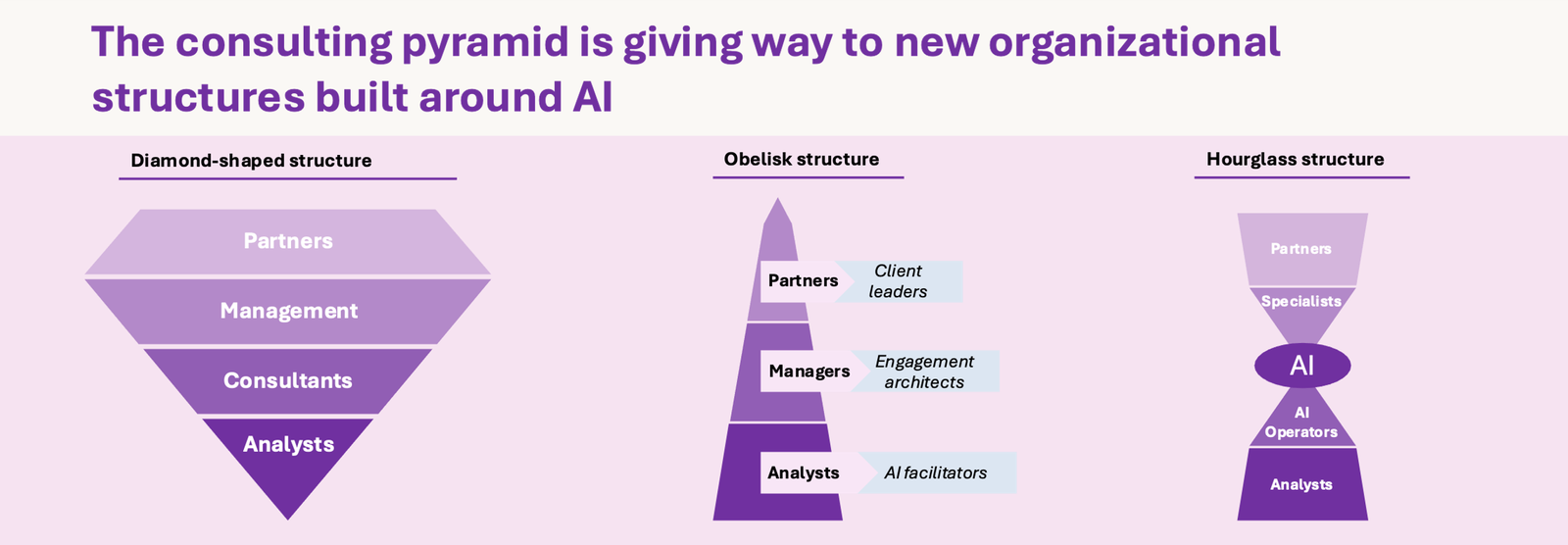
The diamond
The diamond keeps a thin junior base and a small senior tier and widens the middle with experienced, AI-fluent specialists. Firms hire fewer generalist analysts and more mid-career technical staff, including AI engineers. Leverage comes from specialist expertise applied with AI rather than from junior hours.
The obelisk
The obelisk is taller and leaner, with fewer layers, smaller teams and less reliance on juniors. It rests on three redefined roles. AI facilitators are early-career consultants who turn data into insight quickly. Engagement architects are senior consultants who frame problems, judge AI output and turn it into strategy. Client leaders are senior people who hold the trust of executives and advise them on what comes next. The roles cut across levels, and the model is designed for sharper thinking delivered faster with less overhead.
The hourglass
The hourglass places senior advisors at the top, an AI platform in the middle where production happens, and a governance base underneath that validates outputs and keeps them auditable. It is the most explicit of the three about where the risk sits: the narrow waist is the machine, and the base exists to check it.
| Diamond | Obelisk | Hourglass | |
|---|---|---|---|
| Where leverage comes from | AI-fluent specialists in a wide middle | Fewer layers, sharper thinking, less overhead | An AI platform doing the production work |
| Junior base | Thin; fewer generalist analysts | Reduced; juniors become AI facilitators | Thin; analysts and AI operators below the platform |
| Hiring implication | More mid-career technical staff such as AI engineers | Seniors who can frame problems and judge AI output | Senior advisors plus a governance and validation layer |
| Main risk it addresses | Losing expertise depth as juniors shrink | Overhead and slow decision cycles | Unverified AI output reaching clients |
What changes for recruitment and skills
The three shapes reward the same two things: technical skill and governance skill. The diamond hires AI engineers into the middle, the obelisk asks engagement architects to judge AI output, and the hourglass builds a tier whose job is validation. In each case the scarce ability is knowing whether a draft is right and taking responsibility for it, rather than producing the draft.
This changes recruitment. Firms used to hire in volume at the bottom and select for judgment over years of supervised production. Automating the production removes that selection mechanism. Firms will need to hire for judgment and technical fluency earlier, and teach verification deliberately rather than assume people absorb it through repetition. PwC's remark that it still needs juniors for “human skills” makes the same point from the other side: the skills juniors are now hired for are the ones the old model taught last.
What this means for firms and for consultants
For firms, the choice of structure follows from the choice of business model. A firm selling outcomes needs a different structure from one selling reusable assets or premium handmade advice, as set out in how AI is changing consulting business models and pricing. For individual consultants, the skills that defined a strong analyst in 2022, speed and polish in production, are the ones AI has commoditised. The skills each replacement structure pays for are framing the problem, directing the tools, checking the answer, and owning the recommendation in front of the client.
This is an expanded version of chapter 2[3] of The State of AI in Consulting 2026.
Notes and sources
- PwC statements on headcount (2024 to 2025), the withdrawn 100,000-hire target, AI training of 315,000+ staff, and UK graduate applications; remarks by Mohamed Kande (Global Chair) and Phillippa O'Connor (UK Chief People Officer)
- Queen's Tower Advisory, Unity Advisory and Xavier AI, public descriptions of their operating models
- Spaik, The State of AI in Consulting 2026, chapter 2
Figures attributed to third parties are their own reported data; Spaik did not produce those statistics. Where the text offers an interpretation, it is Spaik's own.
Continue reading
- The State of AI in Consulting 2026The full report this analysis is drawn fromRead
- How AI is changing consulting business models and pricingThe economics behind the new shapesRead
- AI agents in consultingThe tools taking over analyst workRead
- AI training for consultantsBuilding the judgment the new structures rewardRead
Working with Spaik
Fewer producers, more people who can judge the output
Each replacement for the pyramid pays for the same skills: technical fluency, verification, and the judgment to direct AI. Spaik builds those skills in consulting teams, from onboarding cohorts to partner sessions, on the firm's own tools.